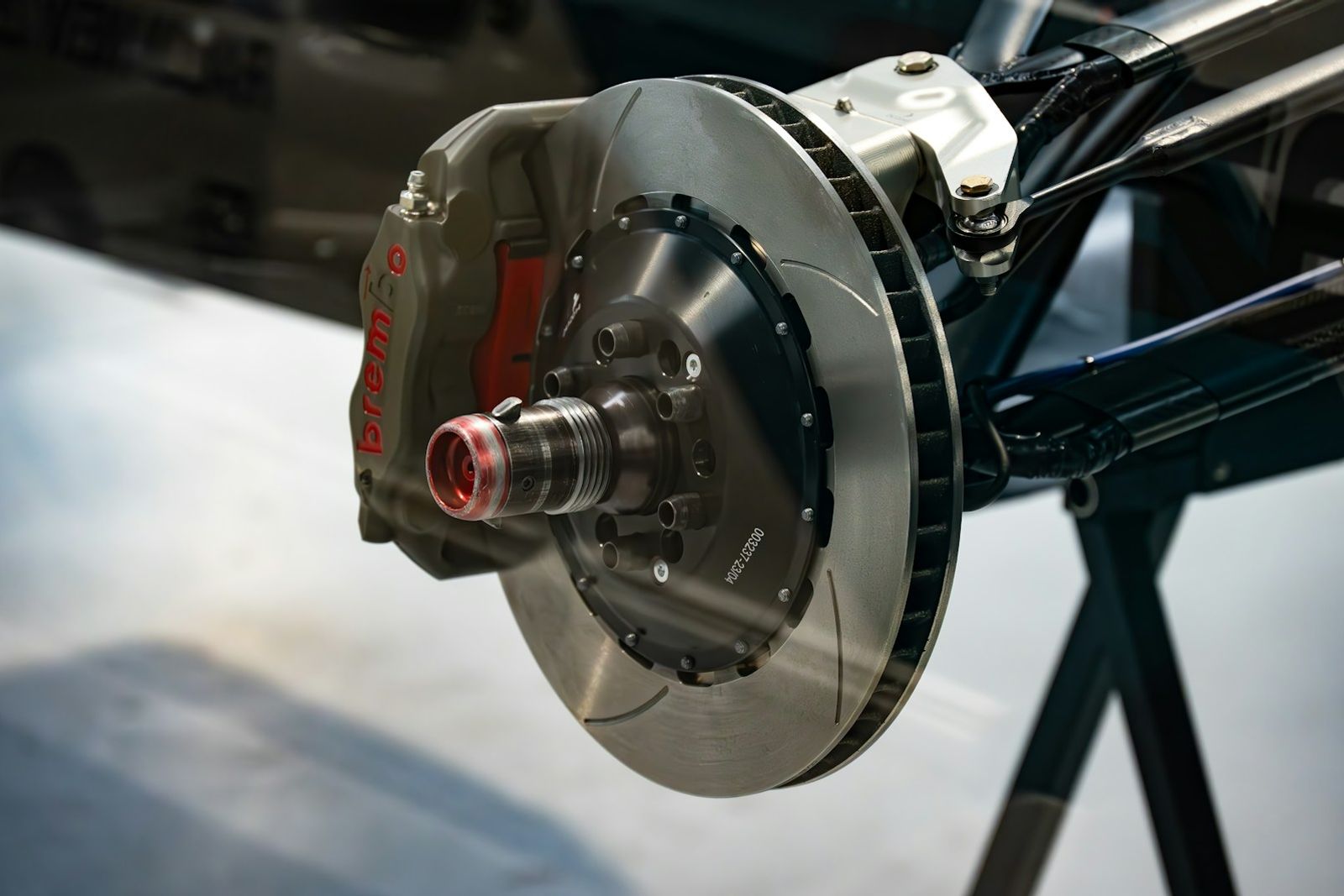
This page is about the combined job. If you only need pads, see the brake pad cost guide. If a shop says only the rotors are bad, the brake rotor guide covers resurfacing and replacement on their own.
Pads and rotors, per axle, by source
| Source | Per axle | Notes |
|---|---|---|
| AAA | $250–$500 | Pads only is $150–$350 |
| iSeeCars | $350 average | Brake service range $250–$500 per end |
| Jerry (estimate page) | $322–$586 | Up to $900+ on some luxury or performance cars |
| eBay Motors | $600–$1,000 | Shop pricing; both axles $1,000–$2,000 |
What changes the price
The biggest swing is the vehicle. iSeeCars says European performance cars such as BMW and Audi cost more than affordable commuters, and that full-size SUVs and pickups cost a bit more than small sedans. Jerry says luxury, electric and performance vehicles run 25% to 100% higher on pads alone, and it quotes up to $900 or more per axle for pads and rotors on some of them.
Then comes the parts tier. A standard rotor is cheap. A coated, drilled or slotted one is not. Pad material matters too: Jerry says ceramic costs roughly $40 to $120 more per axle in parts than semi-metallic.
Third is the shop. Jerry puts dealerships 15% to 40% above independent shops and labor at $100 to $200 per hour. AAA adds that regional labor rates can vary widely across states.
Last is what is under the wheel. Corroded or stuck parts add $50 to $300 on Jerry's numbers. If a caliper is dragging or leaking, expect $300 to $600 or more per corner. Those are not part of the base pad-and-rotor price, and they are where a decent quote can turn into a bad day.
Pads only vs pads plus rotors, per axle and for four wheels
| Job | Per axle | All four wheels |
|---|---|---|
| Pads only | $148–$216 | $296–$429 |
| Pads plus rotors | $322–$586 | $616–$1,092 |
| Rotors added to a pad job | +$150–$400 | N/A |
Part prices if you are comparing a quote to retail
| Part | Price range | Source |
|---|---|---|
| Brake pads | $30–$175 | eBay Motors |
| Rotors (listed range) | $75–$275 | eBay Motors |
| Rotors, each, per AutoZone as cited by iSeeCars | $30–$75 | iSeeCars |
| DIY total parts per axle (pads and rotors) | $35–$175 | eBay Motors |
Parts versus labor on a pad and rotor job
A pad job takes around an hour per axle (AAA). Adding rotors makes it longer: Jerry puts pads plus rotors at 1.5 to 3 hours, and AAA says rotor replacement can take two to three hours. That extra time plus parts is why rotors add $150 to $400 per axle on Jerry's estimate page.
Parts are the smaller piece on a basic car. eBay Motors lists pads at $30 to $175 and rotors at $75 to $275 and puts DIY parts for one axle at $35 to $175. iSeeCars, citing AutoZone, puts rotors at $30 to $75 each. Labor on Jerry's figures runs $80 to $300 per axle for pads alone and makes up 30% to 50% of a brake service.
That split matters when you compare quotes. If a shop quotes $520 for front pads and rotors on a 2017 Toyota Camry and another says $340, ask both for the rotor line item. A premium coated rotor can explain a gap. A larger labor charge with the same part list is a different conversation.
When you really need new rotors
This is where money gets wasted. A pad job does not require new rotors by default.
GM's service bulletin, as summarized by Jalopnik, says to replace rotors only if they do not meet the minimum thickness specification, and not for cosmetic rust, discoloration or a vague complaint of pulsation. BMW's guidance says the same, with a limit: if a rotor is below minimum thickness, pad replacement is prohibited. Minimum thickness is stamped on the rotor, and a technician can check it with a micrometer.
Rotors do need replacing in these cases:
- Below minimum thickness, or too thin to survive another resurface
- Cracked, or deeply scored
- Badly warped, giving pedal pulsation that does not clear after pads
- Heavy heat damage, such as bluing
SlashGear puts typical rotor life at 30,000 to 70,000 miles, and iSeeCars says 20,000 to 75,000 depending on driving style. Because pads often wear out twice in that span, many cars do not need rotors every time. Some do, especially cars with thin, light rotors.
One point that trips people up: resurfacing costs $15 to $40 per rotor by SlashGear's figure, while new rotors cost $30 to $75 each. The gap is small enough that some shops simply replace them. That is a fair call if the quote is clear about it, and a bad one if the rotor measured fine.
Dealer, independent shop or chain
Dealers cost the most (15% to 40% more on Jerry's numbers) and use factory parts. That can be worth it on a car under warranty or one with a specific OEM requirement.
Independent shops give the best balance for most vehicles. Ask which pad and rotor brand they use and whether the quote is for one axle or both.
Chains advertise the lowest numbers. Compare what is in the number: pad material, whether rotors are included, whether hardware is, and how long the warranty runs. AAA says its approved shops give a 24-month, 24,000-mile warranty on parts and labor, and that is the sort of detail worth asking any shop about. Ask for it in writing, along with the pad and rotor brand.
Other items that show up on a brake quote
Brake invoices attract add-ons. Some are real.
- Brake fluid flush. iSeeCars adds $100 to $250 on top of its $350-per-axle figure, and says fluid is generally due about every 30,000 miles. Check the owner's manual first. Jerry's brake fluid page says many automakers specify two to three years. The brake fluid flush guide goes into detail.
- Caliper slide pin service or hardware kit. Jerry puts a hardware kit at $20 to $80 per axle and slide pin service at $80 to $150 as a separate job.
- Parking brake service. iSeeCars says older cars may need it; Jerry lists $60 to $150.
- Caliper replacement. Real only if a caliper is leaking, sticking, or has a seized piston. Jerry lists $250 to $600 installed per caliper. See the caliper guide.
- Wear sensors. Jerry says $25 to $80 per axle on cars that use them.
If the shop recommends several of these at once, ask which one is a safety issue today and which can wait.
How to read the quote
Ask for each line separately: pads, rotors, hardware, labor hours, shop fees, tax. A one-line brake service price hides the rotor decision.
Check these:
- Rotor measurement. Ask for the measured thickness and the minimum stamped on the rotor. A shop that cannot say is guessing.
- Axle. Is the quote front, rear or both? Some are written for all four wheels without saying so.
- Labor hours. Jerry's range is 1.5 to 3 for pads plus rotors. Much more than that deserves an explanation.
- Part grade. Premium or coated parts can explain a higher number. Make sure you chose them.
- Warranty. Parts, labor, and how long.
A clean quote from a good shop is usually a short list. If it grows after the wheels come off, ask for the old part and a reason.
Front, rear, or all four wheels
Most quotes are per axle, so the first question is which axle. Jerry says front pads cost 10% to 20% more than rear pads, because the front brakes do most of the stopping. That is why the front pads and rotors wear out sooner on most cars, and why a shop may recommend the front now and the rear later.
Jerry's four-wheel numbers are the useful ceiling: $616 to $1,092 for pads and rotors on all four wheels, against $296 to $429 for pads only. AAA's pads-only figure for both axles is $300 to $700. If a quote for all four wheels is far above those, ask what is in it.
Pads should be replaced in axle pairs, per Jerry, and rotors are replaced as a pair on an axle too. A shop that offers to do one side only is cutting a corner, and uneven braking on one axle is how a car ends up pulling.
Doing the rear when it is not due is the other trap. Rear pads often last far longer than front ones. If the rear pad measures well above 3 mm, which Jerry gives as the replacement point, the rear can wait, and the $150 to $400 per axle Jerry adds for rotors is money you do not have to spend yet. Ask the shop to show you the measurement, or look through the wheel spokes yourself.
On some cars the rear brakes have an electronic parking brake, and the caliper pistons have to be retracted with a scan tool or a special sequence. That can add labor at the rear, and Jerry lists $20 to $80 for scan-tool steps on its caliper page. If your rear quote is higher than your front quote, that is a common reason, and a fair one.
After the work: bedding in and what to check
New pads and rotors need a break-in. Jerry says to pump the pedal until it firms up before you drive, and to bed the pads with 8 to 10 medium stops from 35 to 45 mph with cool-down driving between them. Skipping that can leave pad material unevenly on the rotor, which is a common cause of pulsation weeks later.
What to check in the first week:
- The pedal should feel firm and consistent, not soft or sinking.
- No pulling to one side under braking.
- No grinding or scraping. A light noise on the first few stops can be normal while pads seat, but a metal sound is not.
- No burning smell after a normal drive, and no wheel that is much hotter than the others.
If the pedal pulses, Jerry says rotor runout above about 0.004 inch can cause it. Rust or debris between the hub and the rotor can do the same. A shop that did the work should be willing to check it, ideally for free, since that is a workmanship issue.
Keep the invoice. The AAA article says its approved shops give a 24-month, 24,000-mile warranty on parts and labor, and a warranty like that is worth having in writing from any shop. Brakes are safety equipment, so if something feels wrong after a brake job, take it back instead of waiting.
Doing it yourself
DIY parts for one axle are $35 to $175 on eBay Motors' figures. Jerry says DIY saves $80 to $300 per axle in labor, and a first-timer should plan one to three hours per axle against 45 to 90 minutes for a pro.
To do pads and rotors, you need a jack, stands, a socket set, a torque wrench, brake cleaner and grease, and a way to clean the hub where the rotor sits. Rust on the hub is the usual time sink.
Brakes are safety equipment. If you are unsure about torque, caliper hardware or bleeding, take it to a professional. Pump the pedal before driving, and bed the pads in per the pad maker's instructions. Jerry recommends 8 to 10 medium stops from 35 to 45 mph.
Sample invoice
Sample invoice: front pads and rotors on a 2017 Toyota Camry at an independent shop
- Front brake pads, ceramic
- $85
- Front rotors, pair, standard
- $110
- Hardware clips and grease
- $15
- Labor, 2.0 hours at $115
- $230
- Total
- $440
An illustration built from the ranges above, not a quote. Fluid flush, tax and shop fees are not included.
How to pay less
- Ask for the rotor thickness measurement and the stamped minimum before agreeing to new rotors.
- Get two written quotes with parts and labor separate, and compare rotor and pad grades.
- Choose standard rotors and semi-metallic pads if your car came with them.
- Replace pads on time (about 3 mm) to avoid scoring the rotors.
- Skip the fluid flush unless it is due by your owner's manual or the fluid looks dark.
- Compare the dealer to an independent shop; Jerry puts dealers 15% to 40% higher.
Questions owners ask
How much does it cost to replace pads and rotors on all four wheels?
Jerry puts it at $616 to $1,092. AAA's per-axle range of $250 to $500 implies roughly $500 to $1,000 for four wheels. Dealers and larger vehicles go higher.
Should I replace pads and rotors at the same time?
Only if the rotors need it. GM's service bulletin says to replace rotors only if they do not meet the minimum thickness spec. Rotors that are thick enough, flat and not cracked can usually take new pads.
How long do rotors last?
SlashGear gives 30,000 to 70,000 miles. iSeeCars says 20,000 to 75,000. Heavy braking and stop-and-go driving shorten that.
Is resurfacing rotors cheaper than replacing them?
Resurfacing is $15 to $40 per rotor by SlashGear's figure, and new rotors are $30 to $75 each. The gap is small, so some shops just replace them. Resurfacing only works if the rotor stays above minimum thickness afterward.
Why do some quotes say $900 per axle?
Luxury, performance and some electric vehicles run higher, and Jerry says some exceed $900 per axle. Dealer pricing and premium coated rotors add to it.
Do electric cars need new rotors less often?
iSeeCars says regenerative braking extends pad and rotor life. A yearly visual check is still worth it.
Sources
- How much to replace brake pads, AAA, checked November 23, 2026pads and rotors range per axle, labor hours, warranty
- How Much Does Brake Pad Replacement Cost?, Jerry, checked November 23, 2026per-axle and four-wheel ranges, rotor add-on, hours, dealer markup
- Brake Pad and Rotor Replacement Costs: What to Expect, eBay Motors, checked November 23, 2026shop range, part price ranges, DIY parts
- Cost of Brake Pads and Rotors, iSeeCars, checked November 23, 2026average per axle, rotor life, fluid add-on, vehicle-type notes
- When To Resurface Brake Rotors, And When You Should Just Replace Them, Jalopnik, checked November 23, 2026GM and BMW minimum-thickness guidance
- How Often Your Brake Rotors Need Replacing, SlashGear, checked November 23, 2026rotor life, rotor price, resurfacing cost, warning signs