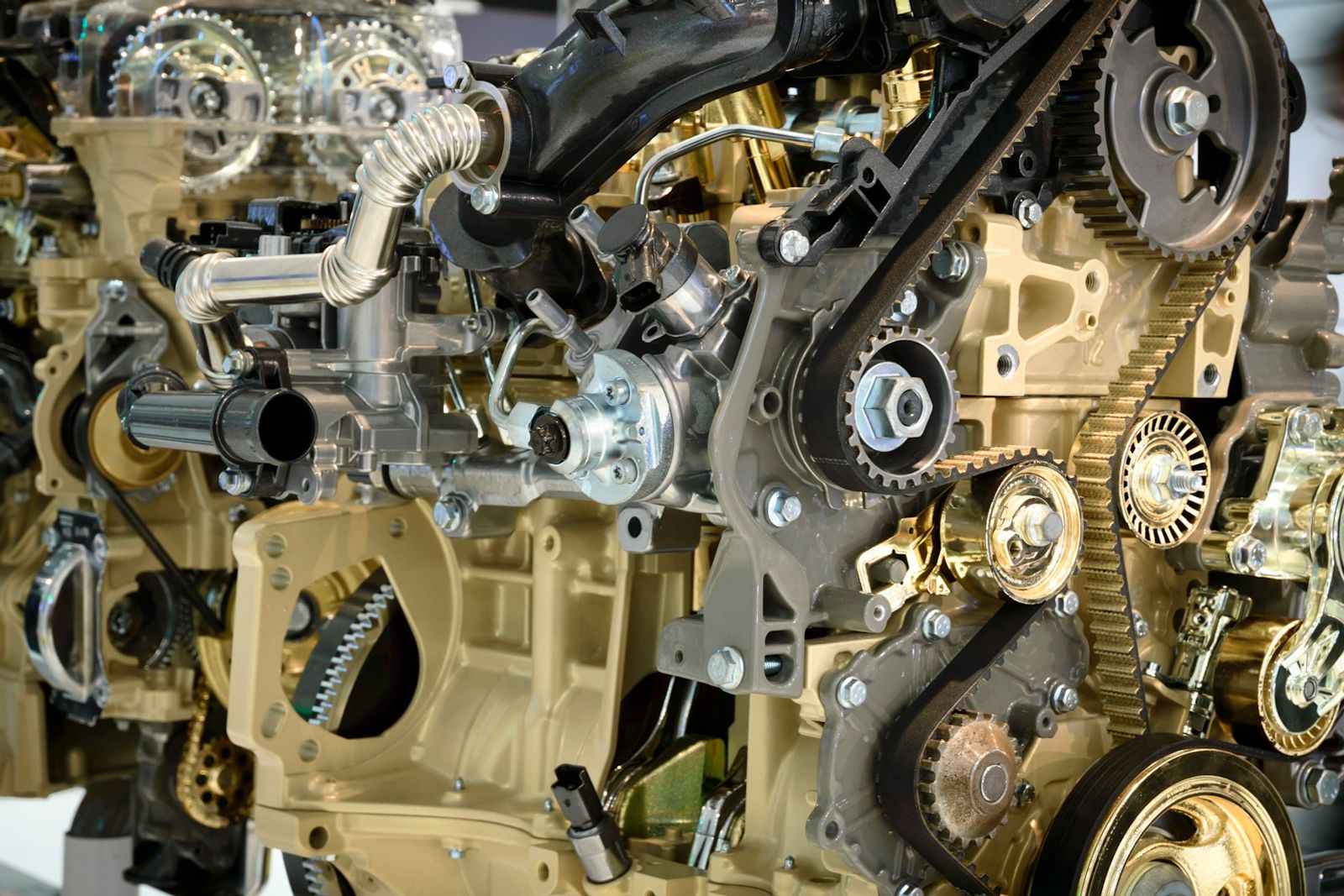
The reason to pay it on time is simple. On many engines the belt keeps the valves and pistons in sync, and when it breaks the engine can wreck itself. If your car has a timing chain instead of a belt, this guide does not apply, and the section below on belts versus chains explains the difference.
Example totals by vehicle
| Vehicle | Reported total |
|---|---|
| Compact Toyota Corolla | Under $800 |
| Honda Civic | $439–$617 |
| Ford Escape | Can top $1,500 |
| V6 Ford SUV | Well past $1,000 |
| Luxury or European models | Often over $1,000 |
| Ford F-150 | Can exceed $3,000 |
What changes the price
Almost everything depends on how far the shop has to take your engine apart to reach the belt.
On a four-cylinder with the belt at the front, it is a few hours of work. Sunbit puts the typical job at 3–5 hours and says complex layouts can run 8 hours or more. Jerry's estimate is also 3–5 hours. Labor is the big piece, 50–70% of the total in Sunbit's breakdown.
Vehicle examples show how much that matters. Sunbit lists a Honda Civic at $439–$617, a compact Toyota Corolla under $800, a Ford Escape that can top $1,500 and a Ford F-150 that can pass $3,000. Luxury and European cars are often over $1,000.
Three factors move the number most:
- Engine layout. V6 and V8 engines with transverse mounting usually need more teardown than a simple four-cylinder.
- Hourly rate. Sunbit lists about $80 an hour at a rural independent, $120–$150 at an urban independent and over $200 at a big-city dealer.
- What else is replaced. The kit, the pump and seals all change the parts side.
Where an $800 job goes
| Line | Share of total | Dollar figure |
|---|---|---|
| Labor | 69% | $290–$1,100 range, about $550 in the example |
| Belt kit (belt, tensioner, idlers) | 18% | $100–$350 range |
| Water pump | 10% | $50–$350 range |
| Gaskets and seals | 3% | $20–$50 range |
Shop labor rates
| Shop type | Hourly rate |
|---|---|
| Rural independent | About $80 |
| Urban independent | $120–$150 |
| Big-city dealership | Over $200 |
Parts versus labor
The kit is the smaller half. Both Jerry and Sunbit put a belt kit at $100–$350. Sunbit says an OEM kit runs $100–$150 more than an aftermarket one, and that adding components raises the parts cost by $50–$350.
A proper job is not just a belt. The tensioner and idler pulleys wear out on the same schedule, and Sunbit suggests replacing one to three idlers. Gaskets and seals add $20–$50.
Labor does the heavy lifting on the bill. Sunbit's mid-range example is about $800, with labor at roughly 69%. That fits the Jerry estimate of $400–$1,000. If a shop's total comes in far below those ranges, ask what is left out of the quote, such as the pump or the seals. If it is far above, check the engine layout. A transverse V6 can legitimately cost much more than a four-cylinder.
The water pump question
On many engines the same belt that times the valves also turns the water pump. That is the one add-on that earns its price.
Jerry says to replace the pump at the same time so both wear out together, and puts the extra cost at about $100. Sunbit lists the pump at $50–$350, about 10% of its $800 example, and notes it only applies when the belt drives the pump.
The reasoning is pure labor. The shop has already done most of the teardown to reach the pump, so the extra cost is mostly the pump itself. Doing it later means paying for the same teardown again.
If the engine uses a timing belt but the water pump is driven some other way, the pump is not a bundled part. Ask the shop to confirm which kind of engine you have before accepting it on the invoice.
Belt, chain and interference engines
Not every engine has a belt. Jerry notes that some cars use a metal timing chain instead, which lasts longer. Sunbit says chains are designed to outlast the engine, but a failure costs more because it often needs a partial engine teardown. Neither source gives a chain repair price, so I will not quote one.
If you do have a belt, the interval is the part to follow. Jerry says the manufacturer's schedule is typically between 70,000 and 90,000 miles. Your owner's manual overrides that. Some manufacturers also have a time limit.
The stakes depend on the engine. In an interference engine, a broken belt lets the valves and pistons collide, and Sunbit says that can bend valves and damage pistons. It puts after-failure repairs at $2,000–$5,000 in the interference case, and as high as $10,000 or more in its wider range. In a non-interference engine the car just stops. Your owner's manual or a repair database will tell you which kind you have. If you buy a used car with a belt and no service record, Sunbit's advice is to replace it right away.
Dealer, independent shop or chain
Because labor is so large here, where you go matters more than on parts-heavy jobs. Sunbit says independent shops reportedly undercut dealer labor by 15–30%.
On a 2012 Honda Civic or a 2014 Toyota Corolla with a belt, any competent independent shop can do this, and a written quote from two of them will usually settle the price. A dealer makes more sense when the engine is unusual, when special tools are required, or when the car is still under a factory warranty.
Ask three questions wherever you go:
- Does the quote include the tensioner and idlers?
- Is the water pump included, and is it driven by the belt?
- Are the seals and gaskets on the same invoice?
If the answers are no, no and no, it is likely a belt-only quote, and the price should be lower than the kit-plus-pump range.
How to read the quote
A full quote has a kit line, a water pump line (if applicable), seals, coolant, labor hours and a rate.
Coolant matters. Draining the system to replace the pump means fresh coolant afterwards. It is not a scam line, but it should be priced like coolant, not like a service package.
Padding shows up in a few predictable spots:
- Labor hours higher than the 3–5 hour norm without a reason such as a V6 or tight engine bay.
- Premium kit pricing when a good aftermarket kit would do. Sunbit puts the OEM premium at $100–$150.
- Extra services bundled in. Drive belts, spark plugs and seals can be real needs, but each should be a separate line.
BLS lists the median pay for automotive service technicians at $24.34 an hour as of May 2025. That is what the technician earns, not what you pay. The shop rate covers overhead, tools and insurance, which is why $120–$150 an hour is common in cities.
When to do it and how to budget
Because this is a large scheduled bill, the smartest move is to plan for it rather than react to it.
Jerry says the manufacturer's schedule is typically between 70,000 and 90,000 miles. Sunbit gives no mileage but says to replace the belt on schedule, or immediately if the service history is unknown. Your owner's manual has the specific number and sometimes a time limit as well. If your car is approaching that mark, start getting quotes a few months ahead so you are not choosing a shop in a hurry.
A rough budget from the sources: plan for $500–$1,400 on most cars and more on some trucks and luxury models. Sunbit says a failure can bring $2,000–$10,000 or more in engine repairs, with a narrower $2,000–$5,000 for interference-engine damage. Compared with that, even the high end of the scheduled job looks like the cheaper path.
There is one more reason to avoid waiting. If the car has a broken belt, you may also need a tow, and the repair then includes diagnosing the damage. Jerry notes that with a broken belt the starter may still crank, but the engine will not start, so it is easy to confuse with other no-start problems. Plan the service while the car still runs.
If you cannot afford the full job now, ask the shop what is essential. The belt, tensioner and idlers are the core of it. The pump is the item most worth adding if it is belt driven. Seals and coolant depend on what the shop finds.
Buying a used car with a timing belt
A timing belt is one of the first things to ask about on a used car with a belt-driven engine.
Ask for the service record. A receipt that shows the belt, the tensioner and the water pump replaced at a specific mileage is worth real money, and Sunbit's advice for an unknown history is to replace the belt right away. Budget for it up front. On a $6,000 used car, an $800 belt job is a meaningful part of the price, and you can use it in your negotiation.
Check whether the car has a belt or a chain. Jerry notes some cars use a metal chain instead, which lasts longer, and Sunbit says chains are designed to outlast the engine. A used car with a chain avoids this scheduled bill, though Sunbit says a chain failure costs more because it often needs partial engine teardown.
If the seller cannot tell you the history, a pre-purchase inspection from an independent shop can at least tell you whether the engine has a belt and what the manual's interval says. Do not rely on the seller's word that it was done recently without paperwork.
Should you do it yourself
Probably not unless you have done one before. A kit costs $100–$350, so the savings are real, but the job punishes small mistakes.
If the belt jumps even one tooth, valve timing is off. On an interference engine that can bend valves the first time you start it. You also need the right torque specs, a way to lock the crank and cams in place, and the correct tools for your engine.
A second reason to skip it is the water pump. If it is belt driven, you are better off doing the pump at the same time, and that adds parts and coolant.
If you want to learn, a lower-risk first project is a serpentine belt or spark plugs, not timing.
Sample invoice
Sample invoice: timing belt service on a 2010 Honda Accord V6
- Timing belt kit with tensioner and idlers
- $230
- Water pump
- $130
- Seals and gaskets
- $35
- Coolant
- $30
- Labor, 4.5 hours at $130
- $585
- Total
- $1,010
An illustration using ranges from Sunbit and Jerry (kit $100–$350, pump $50–$350, seals $20–$50, 3–5 hours). The coolant cost and hourly rate are my assumptions, not a quote.
How to pay less
- Get the interval from your owner's manual, not a shop's sticker. Do not go early, and do not go late.
- Ask for an itemized quote with kit, pump, seals, coolant and hours on separate lines.
- Compare two independent shops. Sunbit says independents reportedly undercut dealer labor by 15–30%.
- Do the water pump with the belt if the belt drives it. The extra labor is minimal compared with a repeat job.
- Put the job off only if you are well inside the interval. On an interference engine, a failed belt costs more than the job.
Questions owners ask
How much does a timing belt cost to replace?
Jerry says about $400–$1,000. Sunbit says $500–$1,400 or more, with a worked example of about $800. Labor is most of it.
How often should a timing belt be replaced?
Jerry says the manufacturer's schedule is typically between 70,000 and 90,000 miles. Follow your owner's manual, because it is specific to the engine.
Should I replace the water pump with the timing belt?
If the belt drives the pump, yes. Jerry advises doing both together and puts the added cost at about $100. Sunbit says the pump costs $50–$350 and applies only when it is belt driven.
What happens if a timing belt breaks?
The engine stops. On an interference engine, Sunbit says the valves and pistons can collide and cause $2,000–$5,000 in repairs. The starter may still crank, but the engine will not run.
Does my car have a timing belt or a chain?
Check your owner's manual or a parts database for your exact engine. Jerry notes some cars use a metal chain, which lasts longer than a belt.
Why is the labor so high?
The belt sits behind covers, mounts and other parts that must come off first. Sunbit says jobs take 3–5 hours, more than 8 on complex engines, and rates range from about $80 to over $200 an hour.
Sources
- Timing Belt Replacement Cost Estimate, Jerry, checked November 23, 2026total range, kit price, 3–5 hour estimate, water pump advice, replacement interval, symptoms
- Timing Belt Cost: What to Expect and Money-Saving Tips, Sunbit, checked November 23, 2026total range, labor share, shop rates, kit and pump prices, vehicle examples, failure costs, belt vs chain
- Automotive Service Technicians and Mechanics, U.S. Bureau of Labor Statistics, checked November 23, 2026median technician pay ($24.34 an hour, May 2025)