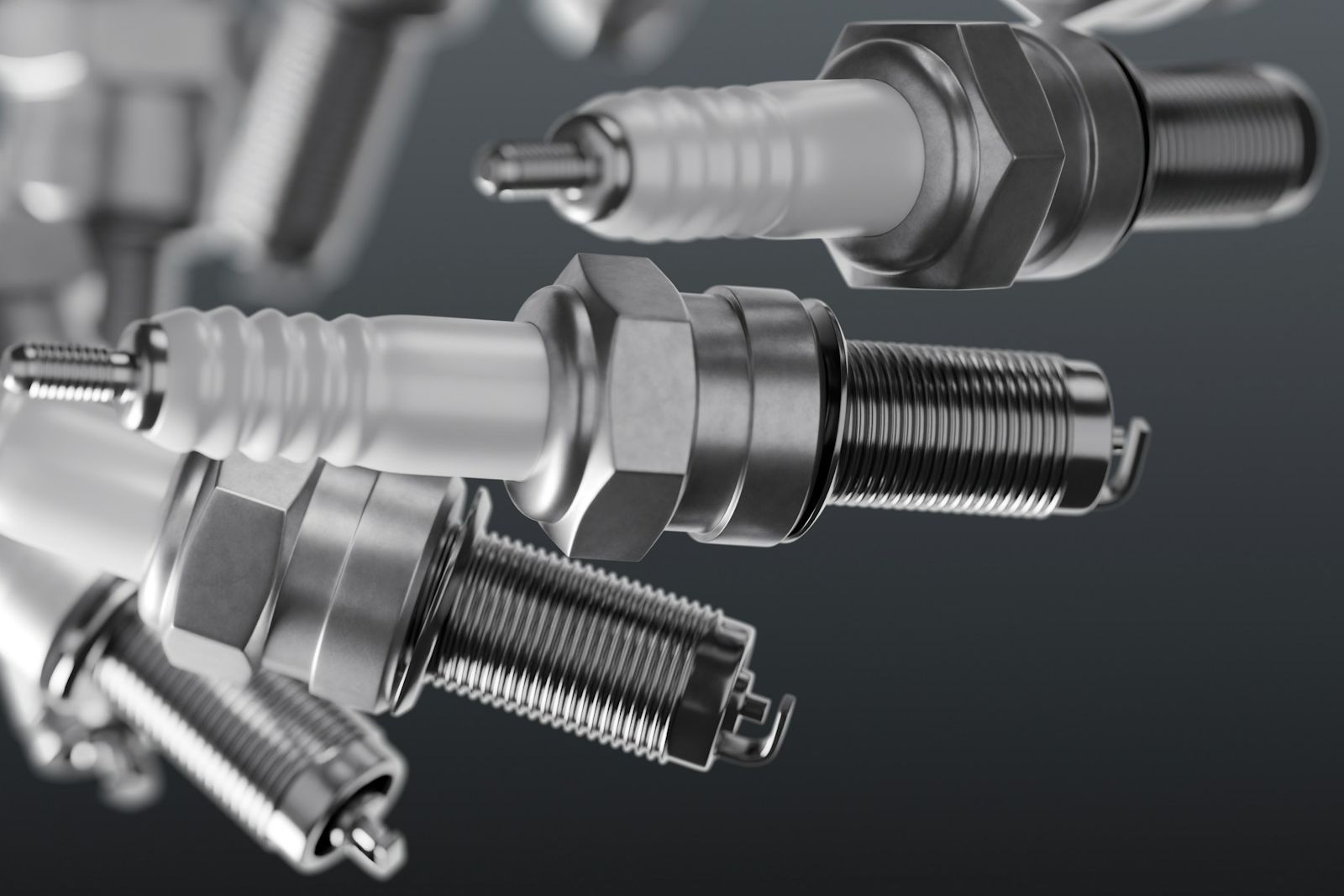
That access time is where a quote can get inflated. A V6 with plugs buried under the intake manifold is a very different job from a four-cylinder with the coils sitting on top. Check your engine before you accept a number.
Total cost by engine size
| Engine | Parts and labor |
|---|---|
| Four-cylinder | $100–$250 |
| V6 | $150–$350 |
| V8 | $200–$500 or more |
What changes the price
Cylinder count and access explain nearly everything.
Most cars need one plug per cylinder, and AAA says modern vehicles have four to eight cylinders. Sunbit notes that some performance or turbocharged engines use two plugs per cylinder, which doubles the count. That is why a V8 job runs $200–$500 or more while a four-cylinder is $100–$250.
Access is the second factor. AAA says V8 totals can climb past $500 when plugs are hard to reach or premium parts are needed, and Sunbit says hard-to-reach engines push the labor toward the high end.
Plug type matters less than people expect. Iridium plugs at AAA's $12–$25 each cost more than copper at $2–$5, but across four cylinders the difference is small next to labor. What it buys you is longer life, which means fewer visits.
Last, the shop. AAA's labor range is $40–$150 per hour, and dealer work lands at the top of the totals.
Plug type, price and life
| Type | Price each | Typical life |
|---|---|---|
| Copper | $2–$5 | 20,000–30,000 miles |
| Single platinum | $6–$12 | Up to 60,000 miles |
| Double platinum | $10–$18 | 60,000–100,000 miles |
| Single iridium | $12–$20 | Up to 100,000 miles |
| Double iridium | $16–$25 | Up to 120,000 miles |
Parts versus labor
On a four-cylinder with four plugs at $5–$25 each (AAA), the parts are $20–$100. The rest of a $100–$250 invoice is labor, shop fees and tax.
There is a disagreement among sources worth knowing about. Sunbit, citing J.D. Power, lists labor from $40 to $350 for the job, which is a very wide band.
What this means for you: if a shop quotes $350 for four plugs on a 2015 Toyota Camry with an easy four-cylinder, ask them to explain the hours. If the same shop quotes $350 for a V6 where the intake manifold has to come off, that is inside AAA's range.
The fix is simple. Ask for the plug brand and type, the number of plugs and the labor hours as separate lines.
Which plugs to buy and how often
Use the plug your owner's manual specifies. Both sources say the manual lists the interval for your model. Sunbit says most vehicles need replacement every 30,000 to 100,000 miles, depending on plug type and engine. AAA puts the range at 20,000 to 100,000 miles overall, and up to 120,000 for double iridium.
The practical rule is that a modern car with iridium plugs from the factory can go a long way between changes, and the manual is the schedule to follow. A shop that tells you to swap plugs every 30,000 miles on a car specified for 100,000 is selling you time, not need.
Do not upgrade to a different type just because it sounds better. AAA says many iridium and platinum plugs come pre-gapped and should not be adjusted. Put in what the engine was designed for unless the manual says otherwise.
Sunbit says mechanics typically recommend replacing all plugs at once to avoid uneven performance. That is a fair recommendation, not an upsell.
Related repairs: real ones and padding
Plug jobs attract add-ons. Some are legitimate.
Often real:
- Coil packs or plug wires with visible damage. Sunbit says worn or corroded wires and coil packs add to the total. If a coil is cracked, oil-soaked or throwing a misfire code for that cylinder, replace it.
- A misfire diagnosis. If your car is misfiring, the plug may be the cause, but not always.
Often padding:
- Replacing every coil by default on a high-mileage car when only one has a code.
- Fuel system cleaning or an induction service added to a tune-up. Neither source lists these as part of a plug job.
- A 'tune-up' package with items you cannot identify. Ask for each line by name.
Sunbit also lists possible damage from ignoring bad plugs, including harm to the cylinder head, plug wires, coil packs or catalytic converter. That is a good reason not to run a misfire for months, but it is not a reason to approve parts that are working.
Signs you need new plugs
AAA lists starting difficulty, rough idling, misfires, poor fuel economy, sluggish acceleration and rattling or popping noises. Sunbit adds noticeable power loss and increased emissions.
A flashing check engine light means an active misfire and deserves prompt attention. Do not keep driving hard on it. A steady light with a misfire code is less urgent but still worth a visit soon.
If the car is under the interval and still runs fine, you do not need to replace plugs early because a shop suggests it. If you are at the interval, do it before symptoms show, since worn plugs are what hurt fuel economy and emissions first.
How to read the quote
A clear quote has the number of plugs and their type, labor hours, and any additional part with a reason.
For a typical car, compare against AAA's ranges: $100–$250 for four cylinders, $150–$350 for V6 and $200–$500 or more for V8. A quote above those with no explanation is worth questioning.
Common things to ask:
- Does the quote include coil packs, and why?
- Are the plugs the OEM-specified type?
- How many hours is the book time for my engine?
- Is the hourly rate in the $40–$150 band AAA gives, or higher?
AAA's range for labor, $40 to $150 per hour, is wide. If a shop is well above $150, that may be a big-city or dealer rate. It is your call whether the premium is worth it for a job this simple.
Why engines differ so much
Not all plug jobs are equal, and the engine layout explains the price better than the plug brand.
On many four-cylinder engines the plugs sit under individual coils on top of the engine. You pull the coil, pull the plug and drop in the new one. AAA's four-cylinder range of $100–$250 reflects that kind of job.
On a V6 or V8 the plugs can be on both sides of the engine, and some are hidden under the intake manifold or other parts. AAA lists $150–$350 for a V6 and $200–$500 or more for a V8, especially if plugs are hard to reach or premium parts are needed. A transverse V6 in a front-wheel-drive crossover is a common example of a harder job.
Turbocharged engines are the other source of surprises. Sunbit says some performance or turbocharged vehicles use two plugs per cylinder, so the part count doubles. Turbo engines also tend to be sensitive to plug condition, so follow the manual's schedule, which may be shorter than for a naturally aspirated engine.
When you request a quote, give the shop your year, make, model and engine size. Ask how many plugs the engine has and what the book labor time is. If the shop cannot answer, it has not looked up your car.
When it is not the plugs
A misfire or rough idle does not automatically mean the plugs are worn, and replacing them without a diagnosis is a common way to spend $200 and still have the problem.
Sunbit lists symptoms such as misfires, reduced fuel economy and rough idling for bad plugs, but those same symptoms can come from a coil pack, a plug wire, a fuel injector or a vacuum leak. Sunbit also says worn or corroded wires and coil packs add to the total.
If your car is under its recommended plug interval and misfiring on one cylinder, the code usually names the cylinder. A shop can swap the coil with a neighboring cylinder to see whether the misfire moves. That is a quick, cheap test, and it is better than replacing a full set of plugs and coils on a guess.
If you are at or past the interval, replace the plugs first, since it is the cheapest piece and is due anyway. If the misfire remains after that, move on to the coils. Do not ignore a flashing check engine light. Sunbit says continuing to run on bad plugs can damage the cylinder head, plug wires, coil packs or catalytic converter, which would turn a $150 repair into a much larger bill.
Doing it yourself
On many four-cylinders, plugs are one of the more approachable DIY jobs. The parts are $20–$100 for a set by AAA's per-plug price and cylinder count.
AAA's safety steps are worth following: disconnect the negative battery terminal and let the engine cool first. Do not adjust pre-gapped iridium or platinum plugs. Tighten to the manufacturer's torque spec, because over- or under-tightening can damage the engine.
If the plugs sit under the intake manifold, or if previous owners have cross-threaded or seized plugs, a shop is the safer choice. A snapped plug in an aluminum head can turn a $200 job into a repair that costs far more.
Sample invoice
Sample invoice: plugs on a 2015 Toyota Camry 2.5L four-cylinder
- Iridium spark plugs, 4 at $16
- $64
- Labor, 1.0 hour at $100
- $100
- Shop fees and tax
- $15
- Total
- $179
An illustration built from AAA's per-plug and hourly ranges and its four-cylinder total of $100–$250. The labor time and fees are my assumptions, not a quote.
How to pay less
- Follow the owner's manual interval and decline early replacement without a symptom.
- Ask for plug type, count and labor hours as separate lines.
- Only replace coil packs or wires that are damaged or code for a misfire.
- Compare two independent shops, since AAA's labor range runs $40–$150 an hour.
- On an easy four-cylinder, a DIY set costs about $20–$100 in parts.
Questions owners ask
How much does it cost to replace spark plugs?
AAA says $100–$250 for a four-cylinder, $150–$350 for a V6 and $200–$500 or more for a V8. Sunbit gives a wider overall range of $100–$500.
How often should spark plugs be replaced?
It depends on the plug type and engine. Sunbit says 30,000 to 100,000 miles for most vehicles, and AAA lists up to 120,000 for double iridium. Your owner's manual is the exact schedule.
Are iridium spark plugs worth it?
If your engine was built for them, use them. AAA lists single iridium at $12–$20 each and up to 100,000 miles, against $2–$5 and 20,000–30,000 miles for copper.
Should I replace all the spark plugs at once?
Yes. Sunbit says mechanics typically recommend replacing them all together to avoid uneven performance.
What happens if I ignore bad spark plugs?
Sunbit lists misfires, reduced fuel economy, power loss and possible damage to the cylinder head, wires, coil packs or catalytic converter.
Can I change spark plugs myself?
On many cars, yes. AAA recommends disconnecting the negative battery terminal, letting the engine cool and following the torque spec. Skip it if the plugs are hard to reach.
Sources
- What Is the Average Spark Plug Replacement Cost?, AAA, checked November 23, 2026totals by engine size, plug prices and life by type, labor rate, symptoms, DIY safety steps
- How Much Do Spark Plugs Cost? A Guide to Replacement and Savings, Sunbit, checked November 23, 2026overall total band, per-plug prices, labor range attributed to J.D. Power, intervals, symptoms, plug counts