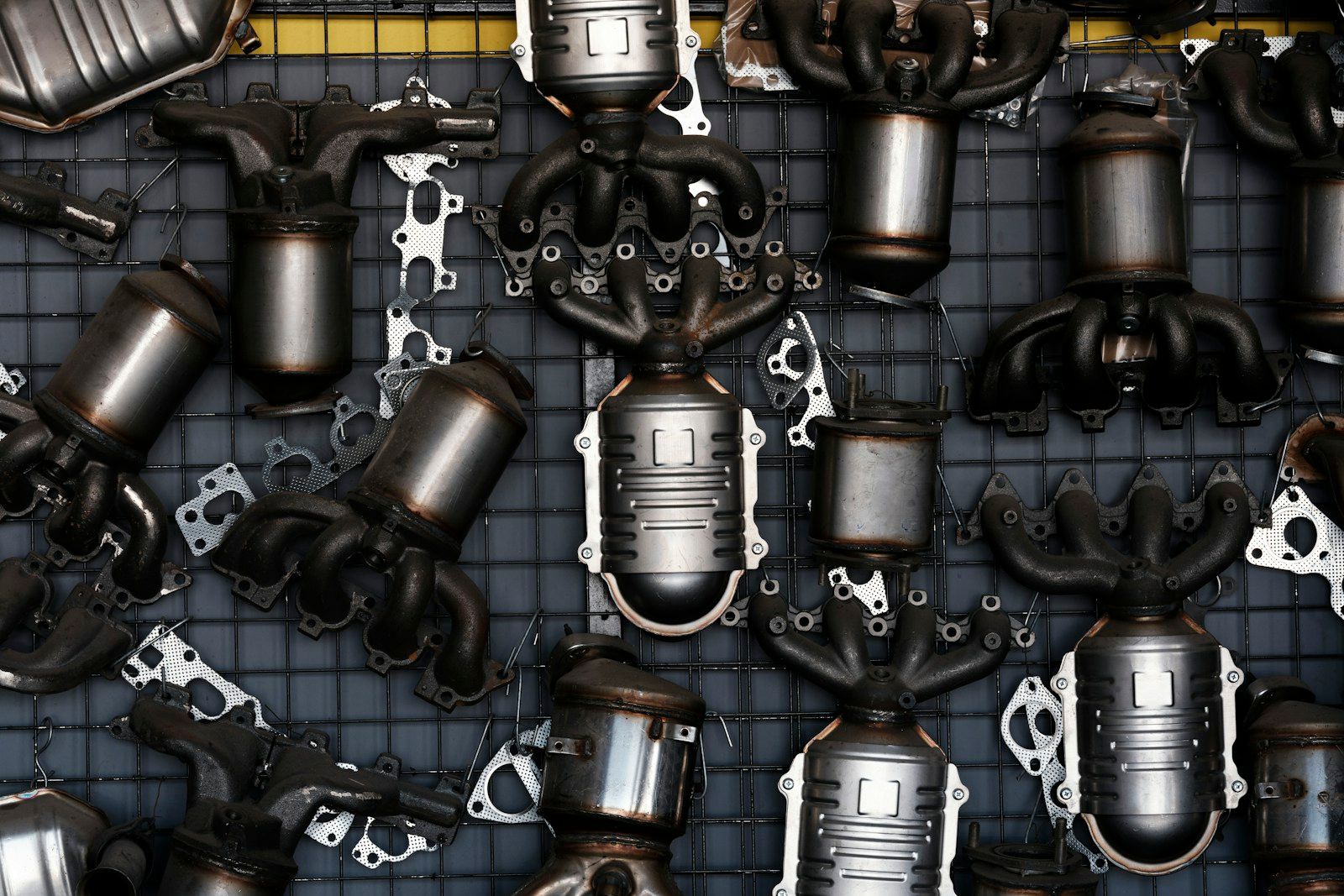
The converter contains precious metals, so the part is expensive even before labor. Before you approve anything, make sure the converter is actually the problem. Codes that point at it can come from sensors, misfires or software, and a new converter will not fix those.
Federal (EPA) versus California (CARB) converters
| Converter type | Independent shop total | Part only |
|---|---|---|
| Federal aftermarket (EPA) | $220–$705 | $129–$359 |
| CARB-approved aftermarket | $320–$1,270 | $232–$924 |
| Genuine (OEM) parts list | Not given, parts only | $1,450–$2,262 before labor |
What changes the price
Four things set the bill: the part, the state, the vehicle and the number of converters.
The part. CarWhere's 2026 data shows an aftermarket federal converter at $129–$359 and a CARB-approved one at $232–$924, across vehicles from a Honda Accord to a Ford F-150. A genuine OEM part list starts at $1,450 and passes $2,200 before labor. AAA says OEM parts cost 40–70% more than aftermarket.
The state. California requires a CARB-approved converter when replacement is truly needed, per CarWhere. The same Ford F-150 left-side converter was $311.79 federal and $915.79 CARB, almost 2.9 times as much. AAA says CARB converters hold more precious metals, and that universal converters are illegal in CARB states.
The vehicle. Hybrids and larger engines typically have pricier converters, according to AAA. A 2010-to-2015 Toyota Prius front exhaust pipe with the converter was $2,262.38 at list price in CarWhere's data, and aftermarket Prius converters ran $430.79–$582.79.
The count. Many cars have more than one converter. Ask whether your quote covers one or both.
AAA's examples by make
| Make | Total | Aftermarket part | OEM part | Labor |
|---|---|---|---|---|
| Honda | $1,000–$2,200 | $200–$400 | $900–$2,000 | $100–$200 |
| Ford | $950–$2,700 | $350–$700 | $800–$2,400 | $150–$300 |
| BMW | $1,450–$4,000 | $700–$1,500 | $1,250–$2,400 | $200–$400 |
Labor time on a Ford F-150 5.0L (recall times)
| Side | Hours |
|---|---|
| Left side | 0.9 |
| Right side | 2.3 |
| Both sides | 2.5 |
| F-150 hybrid, right side | Up to 3.1 |
Parts versus labor
On this job the part is usually the larger piece, which is the reverse of most repairs on this site.
CarWhere's labor figures are 0.9 to 2.3 hours at $100–$150 an hour, so most of a $700 invoice is metal. AAA quotes labor at $160–$200 an hour and shows labor between $100 and $400 across Honda, Ford and BMW examples, with parts running from $200 to $2,400. Those two sources disagree on the total because they measure different things. CarWhere prices an aftermarket part at an independent shop. AAA's figures include OEM parts and shops at higher rates.
A third cost is easy to miss. AAA says the oxygen sensor add-on is about $300 per sensor. A shop that wants to replace the sensors with the converter should explain why. Sometimes the old sensor will not come out of the pipe. Other times it is just an upsell. See our oxygen sensor guide for typical prices.
Federal versus CARB rules and warranty
A converter is an emissions part, so federal and state rules shape what you can install and what you may be owed.
According to CarWhere, the federal emissions warranty covers the catalytic converter for 8 years or 80,000 miles, whichever comes first, on 1995-and-newer vehicles. That is the first thing to check if your car is newer than the cutoff. Jerry's oxygen sensor page says something similar, noting that converters and the engine computer may be covered for 8 years or 80,000 miles. Do not pay out of pocket until you have asked the dealer.
CarWhere adds that EPA allows aftermarket converters only in limited cases, such as when the original is missing or a state inspection requires replacement. New aftermarket converters carry a 5-year or 50,000-mile warranty on the shell and end pipes and must meet EPA emission standards for 25,000 miles. AAA says aftermarket warranty coverage on direct-fit converters is limited.
If you live in California, or in a state that follows its rules, buy the CARB-approved part. A cheaper federal converter can be illegal to install there, which means paying twice.
Make sure it is the converter
A P0420 or P0430 code means the system sees poor converter efficiency. It does not prove the converter itself has failed.
CarWhere gives a real example. On one F-150 PowerBoost issue, Ford's first step is reprogramming the engine computer and running a drive cycle, not replacing the converter. Misfires, exhaust leaks and failed oxygen sensors can set the same code.
Before you approve a four-figure repair, ask for these:
- The actual codes and freeze-frame data.
- Which tests were done (sensor readings, exhaust backpressure, a visual inspection for leaks).
- Whether any misfires or fuel trim issues were fixed first.
A diagnostic fee is fair. A converter quote with no diagnosis behind it is not. Our check engine light guide has typical diagnostic prices.
Theft as a cost driver
Converters contain platinum, palladium and rhodium, and that is why they are stolen. AAA says thieves can remove one in minutes and that scrap buyers pay roughly $100 to $400, depending on condition, vehicle and metal prices.
For your wallet, the result is a repair bill for a part you did not wear out, and sometimes damaged exhaust pipes and wiring on top. The same price rules apply: a federal or CARB part for your vehicle, plus labor. AAA notes that related repairs such as exhaust pipes, heat shields and hardware add cost on top of its table figures.
If your converter was stolen, call your insurer before you buy anything. Whether the loss is covered depends on your policy, and I am not going to guess at coverage terms. Driving without a converter is also illegal in all 50 states according to AAA, so do not leave the car that way.
How to read the quote
A clean converter quote lists the part brand, whether it is federal or CARB, the number of converters, labor hours and any gaskets, hardware or sensors.
CarWhere's price-check method is useful. It treats a quote up to 25% above the top of the expected range as high and anything beyond that as too much. A $1,000 job is fair for a CARB converter but about $295 above the top of the federal range, so it would be too much for a federal one. A quote below the range is also worth checking for what it leaves out.
Common padding to question:
- OEM part on a car that does not need one. Direct-fit aftermarket parts are cheaper, with limited warranty per AAA.
- Sensors replaced automatically. AAA puts them at about $300 each.
- Exhaust pipes and hardware. Sometimes they are rusted through, and sometimes they are fine.
- A diagnostic charge on top of a plain code read. Many parts stores read codes for free, but a diagnostic is a different test.
Why the two price ranges disagree
If you have searched for this price, you have probably seen very different answers. Here is why.
CarWhere's 2026 independent-shop data gives $220–$705 for a federal converter and $320–$1,270 for a CARB one. AAA says $1,000–$4,000 for parts and labor together, with parts alone at $300–$2,500. Both can be right, because they describe different jobs.
CarWhere is pricing aftermarket parts at independent shops, on a sample of vehicles from the Honda Accord to the Ford F-150. AAA's examples include OEM parts, which AAA says cost 40–70% more than aftermarket, and brands such as BMW where the part alone can pass $2,000. AAA also uses a labor rate of $160–$200 an hour, while CarWhere uses $100–$150.
So which should you plan around? If your car is a common mainstream model and you use a direct-fit aftermarket part at an independent shop, CarWhere's range is the realistic one. If you drive a luxury or hybrid vehicle, or your state requires a CARB part, expect the upper end or beyond. Hybrids and larger engines typically have pricier converters, per AAA.
When you collect quotes, ask each shop to say which part they are quoting, federal or CARB, aftermarket or OEM, and how many converters. That makes the quotes comparable, which is the only way to tell whether a price is fair.
A checklist before you approve the job
This is a bill that can reach four figures, so a few minutes of checking pays off.
- Check the warranty. CarWhere says the federal emissions warranty covers the converter for 8 years or 80,000 miles, whichever comes first, on 1995-and-newer vehicles. If your car qualifies, the dealer may owe you the repair.
- Get the codes and the diagnosis in writing. P0420 and P0430 are the codes AAA lists, and CarWhere gives an example where the first fix was a software update, not a converter.
- Confirm the part type for your state. In California a CARB-approved converter is required once replacement is truly needed (CarWhere). AAA says universal converters are described as illegal in CARB states.
- Ask how many converters the quote covers. Many cars have more than one.
- Ask what else is included. AAA says its table figures exclude related repairs such as exhaust pipes, heat shields and hardware, so those lines may show up on the invoice.
- Get a second quote. CarWhere's rule of thumb is that a quote up to 25% above the top of the range is high and anything beyond is too much.
If the shop recommends oxygen sensors at the same time, ask whether the old ones tested bad. AAA puts the add-on at about $300 per sensor, so it adds up quickly.
Doing it yourself
CarWhere puts the part-only DIY cost at $130–$925. The saving is real if you have lift access and the converter bolts on.
Many converters are welded in, rusted or tucked under heat shields, and the job can mean cutting and welding. Exhaust leaks left after a bad install can also trigger new codes.
The bigger issue is legality. Federal rules limit when an aftermarket converter may be fitted, and you must choose the right type for your state. If you are not sure which part is legal for your car, use a shop that does exhaust work and can document the repair.
Sample invoice
Sample invoice: converter on a 2012 Honda Accord (federal state)
- Aftermarket direct-fit catalytic converter, federal
- $390
- Gaskets and hardware
- $30
- Labor, 1.5 hours at $125
- $188
- Shop fees and tax
- $25
- Total
- $633
An illustration. The part price sits at the top of CarWhere's $129–$390 Accord range, labor uses its 0.9–2.3 hour band at $100–$150, and the hardware and fees are my assumptions. It is not a quote.
How to pay less
- Get the diagnosis in writing before you approve a converter. Codes alone do not prove the part has failed.
- Check your age and mileage against the 8-year or 80,000-mile federal emissions warranty before paying.
- Ask for a direct-fit aftermarket part in your state's required type, federal or CARB, not an OEM part by default.
- Compare two independent exhaust shops. CarWhere's ranges are for independent shops and sit far below dealer-style OEM prices.
- Question automatic sensor replacement. AAA puts it near $300 per sensor.
- Ask how many converters the quote covers.
Questions owners ask
How much does it cost to replace a catalytic converter?
CarWhere's 2026 data shows $220–$705 with a federal aftermarket part and $320–$1,270 with a CARB part at an independent shop. AAA's broader estimate is $1,000–$4,000 including OEM parts.
Why are CARB converters more expensive?
AAA says they contain more precious metals. CarWhere's F-150 example was $311.79 for the federal part and $915.79 for the CARB part.
Is a catalytic converter covered by warranty?
CarWhere says the federal emissions warranty covers it for 8 years or 80,000 miles on 1995-and-newer vehicles. Check with the dealer before you pay.
Can I drive without a catalytic converter?
AAA says you physically can, but it is illegal in all 50 states and the car will fail emissions tests.
Does a P0420 code always mean I need a new converter?
No. CarWhere gives an example where the manufacturer's first step is reprogramming the engine computer. A shop should check sensors, leaks and misfires first.
Why do thieves target catalytic converters?
AAA says they contain platinum, palladium and rhodium, can be removed in minutes, and scrap buyers pay about $100–$400. You pay the repair bill, so check your insurance policy.
Sources
- Catalytic Converter Replacement Cost (2026), CarWhere, checked November 23, 2026federal vs CARB price ranges, part prices, labor hours, emissions warranty, aftermarket rules, price-check method
- How Much Does a Catalytic Converter Cost?, AAA, checked November 23, 2026total and parts range, labor rate, make examples, OEM premium, theft, symptoms, sensor add-on
- Oxygen Sensor Replacement Cost Estimate, Jerry, checked November 23, 20268-year or 80,000-mile warranty note on converters